Traditional Sauna vs. Infrared Sauna: What’s the Difference?
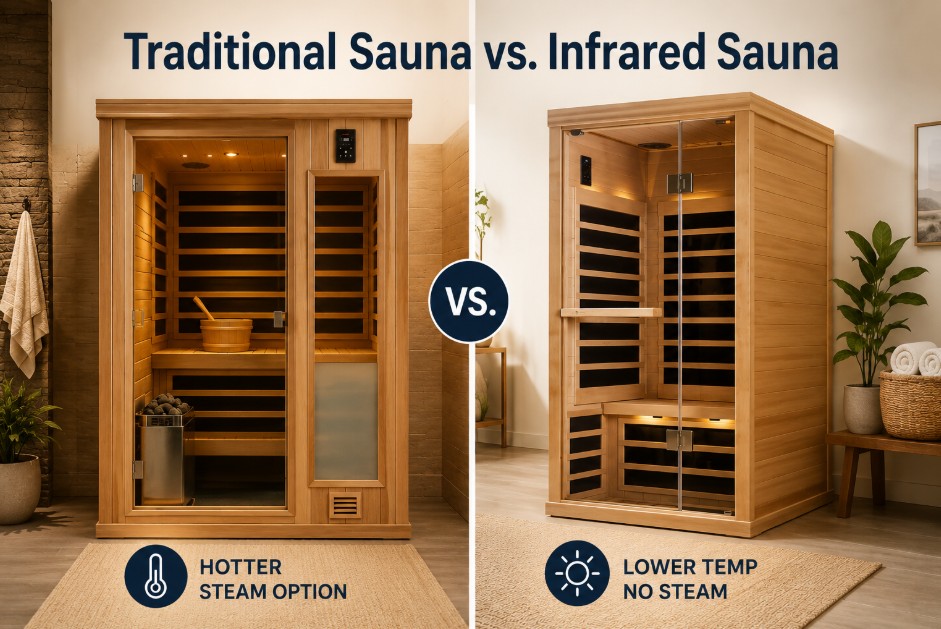
If you’re thinking about adding a sauna to your home, you’ve probably run into this question: traditional or infrared? Both deliver real wellness benefits and both have loyal fans. The difference comes down to how they heat your body, how they feel to use, and which one fits your lifestyle and your space.
At Aurora Pools & Spas in Lexington, we carry home saunas for a range of needs and budgets. Here’s a clear, honest breakdown of both types so you can figure out which one makes the most sense for you.
How Does a Traditional Sauna Work?
A traditional sauna heats the air around you. A heater, typically powered by electricity or wood, warms the room to high temperatures, usually somewhere between 150 and 195 degrees Fahrenheit. You feel the heat through the hot air, and many people add water to heated rocks to create bursts of steam, which raises the humidity and intensifies the experience.
This is the classic sauna experience. If you’ve ever used a sauna at a spa, resort, or gym, that was almost certainly a traditional model. The high heat and optional steam create a deeply immersive environment that many people find both invigorating and relaxing, and it’s easy to understand why it remains the standard for shared sauna experiences with family and friends.
How Does an Infrared Sauna Work?
An infrared sauna works differently. Instead of heating the air, infrared panels emit light waves that are absorbed directly by your body. The room itself stays at a much lower temperature, typically between 120 and 150 degrees Fahrenheit, but your body heats up from the inside out.
Because the air temperature is lower, infrared saunas feel less intense than traditional saunas while still producing a solid sweat. Many people who find traditional saunas uncomfortably hot or difficult to tolerate prefer the infrared experience. Homeowners throughout Lexington, Georgetown, Richmond, and Woodford County have found infrared saunas to be a convenient fit for regular wellness routines.
Traditional Sauna vs. Infrared Sauna: Key Differences
Temperature and Feel
Traditional saunas run hotter and feel more intense. The steam option adds humidity that amplifies the heat. Infrared saunas run cooler and tend to feel gentler, which makes them a good fit for people who are new to sauna use or sensitive to extreme heat.
Neither experience is better than the other. It comes down to personal preference.
Heat-Up Time
Traditional saunas take longer to reach optimal temperature, usually 30 to 45 minutes. Infrared saunas warm up much faster, often in 10 to 15 minutes, which makes them easier to work into a daily routine without planning around a long preheat.
Humidity
Traditional saunas can generate steam when water is poured over the heated rocks, giving you control over humidity during your session. Infrared saunas produce a dry heat environment with no steam option.
If the sensation of warm steam is part of what you love about sauna use, a traditional model may be the better fit.
Installation and Space
Both sauna types can be installed indoors or outdoors, and both are available as prefabricated units well-suited for home installation. Traditional saunas typically require more ventilation planning and a dedicated electrical circuit. Infrared saunas are generally simpler to install and, in smaller sizes, can sometimes run on a standard outlet.
Kentucky homeowners have successfully installed both types in basements, garages, home gyms, dedicated wellness rooms, and outdoor living spaces. Your available square footage and existing electrical setup will help determine which option fits your home best.
Energy Use
Infrared saunas are typically more energy-efficient because they operate at lower temperatures and heat up faster. Actual operating costs depend on the size of the unit, frequency of use, insulation quality, and local utility rates.
Benefits of Traditional and Infrared Saunas
Both traditional and infrared saunas offer wellness and relaxation benefits, but they create different experiences.
Benefits of Traditional Saunas
- Classic sauna experience enjoyed for generations
- Higher temperatures for those who enjoy intense heat
- Steam and humidity options for a customizable session
- Great for shared use with family and friends
- Popular in backyard retreats and dedicated wellness spaces
Benefits of Infrared Saunas
- Lower operating temperatures that many users find more comfortable
- Faster warm-up times
- Energy-efficient operation
- Comfortable for frequent use
- Ideal for homeowners seeking a convenient wellness routine
The best sauna is ultimately the one you’ll enjoy using regularly.
What Factors Affect Sauna Cost?
Sauna pricing varies based on a number of factors, and understanding what drives cost helps you compare options more effectively than focusing on a single number.
Key factors include:
- Sauna type, traditional or infrared
- Indoor versus outdoor installation
- Overall size and seating capacity
- Construction materials and finish quality
- Technology and control features
- Installation requirements and any electrical upgrades needed
Both sauna types are available across a broad range of price points, from accessible entry-level units to premium models with advanced features. The Aurora team can walk you through the categories that fit your space, goals, and budget without overcomplicating the decision.
Why More Kentucky Homeowners Are Adding Saunas
Saunas have become a popular addition to homes throughout Lexington, Georgetown, Richmond, Woodford County, and surrounding Central Kentucky communities.
More homeowners are looking for ways to create personal wellness spaces without leaving home, and a sauna provides a dedicated place to relax, recover, and recharge after work, exercise, or the stress of everyday life.
Whether you’re designing a full backyard retreat, upgrading a home gym, or simply adding a wellness feature to an existing room, a sauna fits into more spaces and lifestyles than most people expect.
Which One Is Right for You?
A Traditional Sauna May Be the Better Fit If You:
- Love the classic high-heat sauna experience
- Enjoy the option of adding steam
- Plan to share the sauna with family or guests regularly
- Prefer a more intense, immersive session
- Want the traditional spa-like atmosphere many people associate with sauna use
An Infrared Sauna May Be the Better Fit If You:
- Find extreme heat uncomfortable or difficult to tolerate
- Want a faster heat-up time for daily use
- Are working with a smaller or simpler installation space
- Prefer a dry heat experience
- Want a sauna that’s easy to incorporate into a regular wellness routine
See Saunas in Person at Aurora Pools & Spas in Lexington
Reading about the differences is a great start, but experiencing both types in person is often what makes the decision clear.
Aurora Pools & Spas serves homeowners throughout Lexington, Georgetown, Richmond, Woodford County, and the surrounding Central Kentucky area. Our showroom gives you the chance to see sauna options up close, compare features, and get straightforward guidance from a team that knows the products.
Whether you’re just beginning to explore or ready to move forward, we’re here to help you find the right fit for your home and lifestyle.
Visit Aurora Pools & Spas in Lexington to explore traditional and infrared sauna options. We proudly serve homeowners throughout Lexington, Georgetown, Richmond, Woodford County, and surrounding Central Kentucky communities.
Frequently Asked Questions
What is the main difference between a traditional sauna and an infrared sauna?
A traditional sauna heats the air around you to high temperatures and allows you to add steam by pouring water over hot rocks. An infrared sauna uses light panels to heat your body directly at lower air temperatures. The experience feels different, but both deliver wellness and relaxation benefits.
Is an infrared sauna better than a traditional sauna?
Neither type is universally better. Infrared saunas offer lower temperatures and faster heat-up times, while traditional saunas provide a hotter, more intense experience with the option to add steam. The right choice depends on your preferences and goals.
Which sauna type is better for beginners?
Many beginners find infrared saunas easier to start with because the lower air temperature feels less intense. Traditional saunas can also be a great option when sessions begin at shorter durations and moderate temperatures.
Do traditional saunas use more energy than infrared saunas?
Generally, yes. Traditional saunas typically operate at higher temperatures and require longer heat-up times. Actual operating costs depend on the size of the sauna, frequency of use, insulation quality, and local utility rates.
Can a sauna be installed outdoors in Kentucky?
Yes. Both traditional and infrared saunas can be installed outdoors when designed for outdoor use. Outdoor saunas are a popular addition to backyards throughout Lexington, Georgetown, Richmond, Woodford County, and surrounding communities.
How often should I use a sauna?
Many sauna owners use their sauna several times per week, while others enjoy daily sessions. The ideal frequency depends on your personal wellness goals and preferences.
Where can I see and buy a sauna in Lexington, KY?
Aurora Pools & Spas in Lexington carries home saunas in a variety of styles, sizes, and configurations. We serve homeowners throughout Central Kentucky and invite you to visit our showroom to compare options in person.